
Separating toilet servicing · UK
Plan a spare urine container around a clear rotation routine
Choose the correct spare bottle and closures, record which container is ready, and set a trip limit without treating storage as disposal permission.
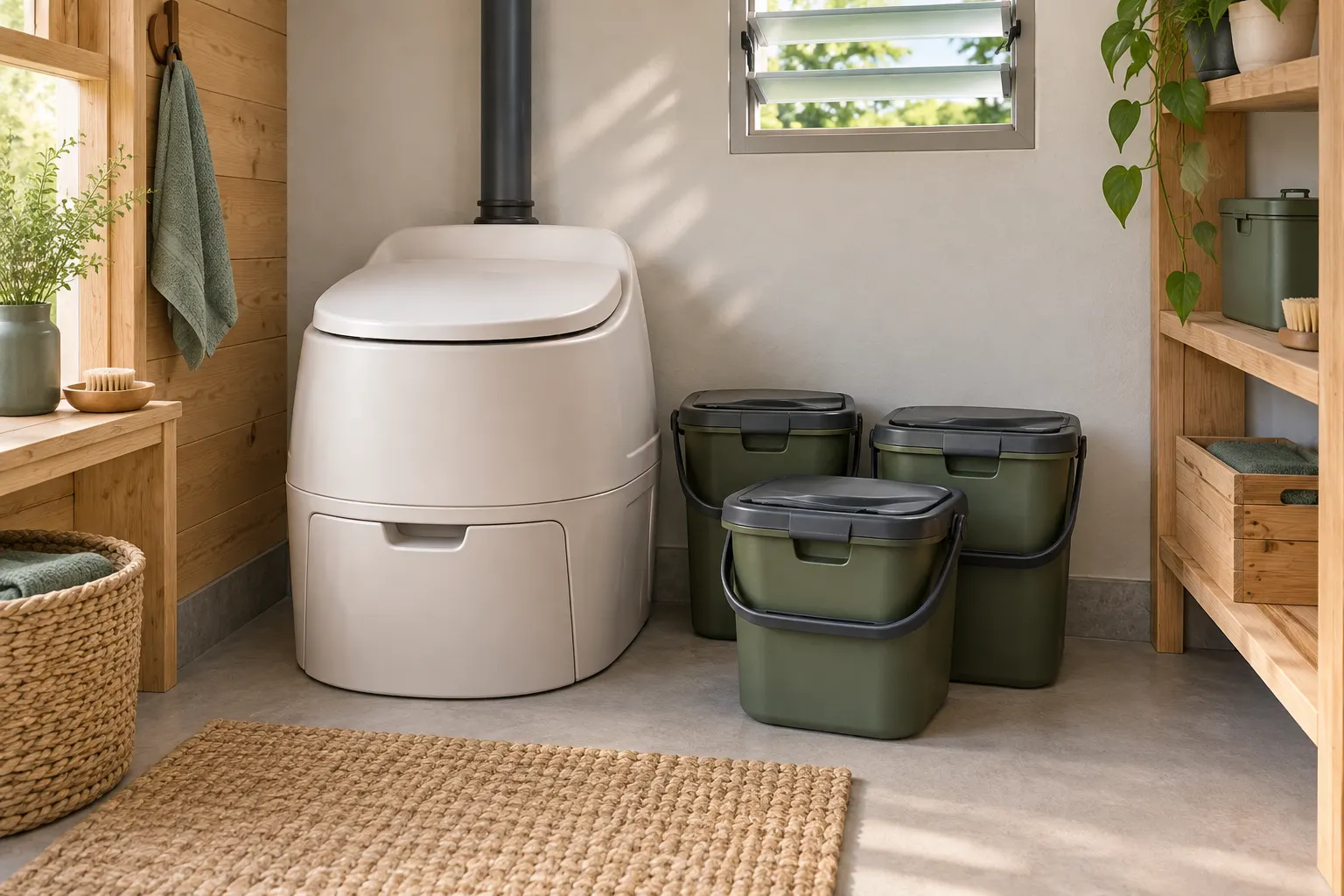
Plan a spare urine container as a complete kit: the correct bottle, its specified closure, an allocated place and a record of whether it is ready to use. Keep disposal arrangements as a separate planning question. A second container gives you another physical container; a product listing cannot confirm permission for your intended disposal route.
The useful decision is whether you can manage that extra container throughout the trip. Before buying one, establish where it will go when removed, how you will identify it and what you will do if your planned servicing opportunity becomes unavailable.
Check the exact model before counting capacity
Start with the toilet’s full model name and the replacement container’s part details. Similar names within a range do not establish a match. Trelino’s large replacement canister page, for example, identifies Origin L and Evo L compatibility and explicitly excludes S and M models. Treat this as a model-specific example, rather than a rule about other brands. Trelino L replacement canister
Record the container, closure and any separate in-use component on one equipment card. Include links to the manufacturer’s information so you can recheck the details when replacing a part. Avoid relying on a photograph or a remembered capacity description.
Nature’s Head’s extra liquids bottle is described as a replacement for its own toilet system and includes a bottle cap. That illustrates a useful purchasing check: establish what accompanies the bottle before assuming you have a complete spare assembly. Nature’s Head extra liquids bottle
The buying decision should therefore end with a confirmed parts list. If compatibility remains uncertain, resolve it with the manufacturer before treating that container as available reserve.
Distinguish the closures
An opening used while the toilet is operating and a closed lid supplied with a spare canister have different roles. Trelino’s L canister listing says it includes a closed lid and excludes the membrane closure. Its separate membrane-lid page describes that component as limiting liquid sloshing back through the inlet. Trelino canister contents, Trelino membrane closure
Nature’s Head separately identifies its replacement bottle cap as a component intended to seal its urine bottle during transport. Use the specified component for the exact system; this description is not evidence that an unrelated cap or container will behave the same way. Nature’s Head spare bottle cap
For model-specific bottle handling, follow the manufacturer’s instructions. Nature’s Head’s online resources include its bottle-removal guidance. Read the instructions relevant to your configuration before a trip rather than improvising the removal sequence in a cramped compartment. Nature’s Head support and resources
Give each container a visible status
A simple rotation record is an organisational recommendation, not a manufacturer-prescribed storage method. Give each container an identifier, such as A and B, and keep a card with four possible statuses: installed, ready spare, removed with contents, or awaiting preparation under the manual.
Write the status in words. A date alone tells the next person very little: it might mean the date of removal, inspection or preparation. Add the date and initials after the status so another user can understand the record without asking what a mark means.
Only mark a container ready after completing the checks and preparation specified for your model. Keep cleaning details on the separate component-by-component cleaning plan. This avoids turning the rotation card into an improvised cleaning recipe.
Agree who updates the card. In a shared van or cabin, the person completing a change should record it immediately. The purpose is to make the next decision obvious: which container can be installed, and which one still requires attention?
Allocate the spare’s space before departure
Make room for the removed container as well as the unused spare. As a planning exercise, walk through both situations with an empty container and check whether the intended location remains accessible with normal luggage aboard. Record where the matching closure belongs so it can be found when needed.
Use the campervan toilet space planner alongside the toilet measurement-sheet guide. Include the route between the toilet and the allocated container space. A storage position is less useful if accessing it requires dismantling the travelling layout.
This rehearsal checks your arrangement and reach. It does not establish that a container is suitable for every storage orientation or travel condition. Follow the exact manufacturer’s requirements wherever those matters are specified.
Set a reserve trigger with a hypothetical example
Suppose, purely hypothetically, your planning allowance is 4 litres per container, with one installed container and one ready spare. Assume the group contributes 2 litres per day to this toilet. The arithmetic gives 8 litres of total allowance and four days of nominal capacity: 2 × 4 ÷ 2 = 4.
Now suppose you reserve one day’s assumed demand. The planned servicing trigger becomes 6 litres collected, or day three under those assumptions. The remaining 2 litres is a contingency allowance in the calculation. These figures are invented planning inputs, not manufacturer fill limits, typical bodily output or a recommended storage duration.
Use the emptying-interval estimator and the capacity planning guide to explore your own assumptions. Keep actual manufacturer limits and observed use separate from nominal container volume.
Write the trip’s stopping condition
Alongside the rotation card, record the servicing arrangement you have independently confirmed and a backup plan if it becomes unavailable. Do not extend a trip simply because another bottle could fit in the vehicle. Extra storage leaves the disposal question unresolved.
Before departure, everyone using the toilet should know the next planned check and the point at which the arrangement needs changing. If you cannot confirm the correct container, closure, space and servicing plan, settle those gaps before relying on a spare. A workable routine is one that the next person can understand and carry out.
Continue planning
Related guides

Portable toilet comparison
Best portable composting toilet for a campervan: keep the trip simple
Capacity planning
Waterless toilet capacity: estimate a realistic emptying interval
Campervan toilet service access