
Ownership cost planning · EU
Which toilet cost assumption could change your decision?
Use ownership-cost scenarios to find the usage threshold and uncertain inputs that could change your choice, with clearly hypothetical arithmetic.
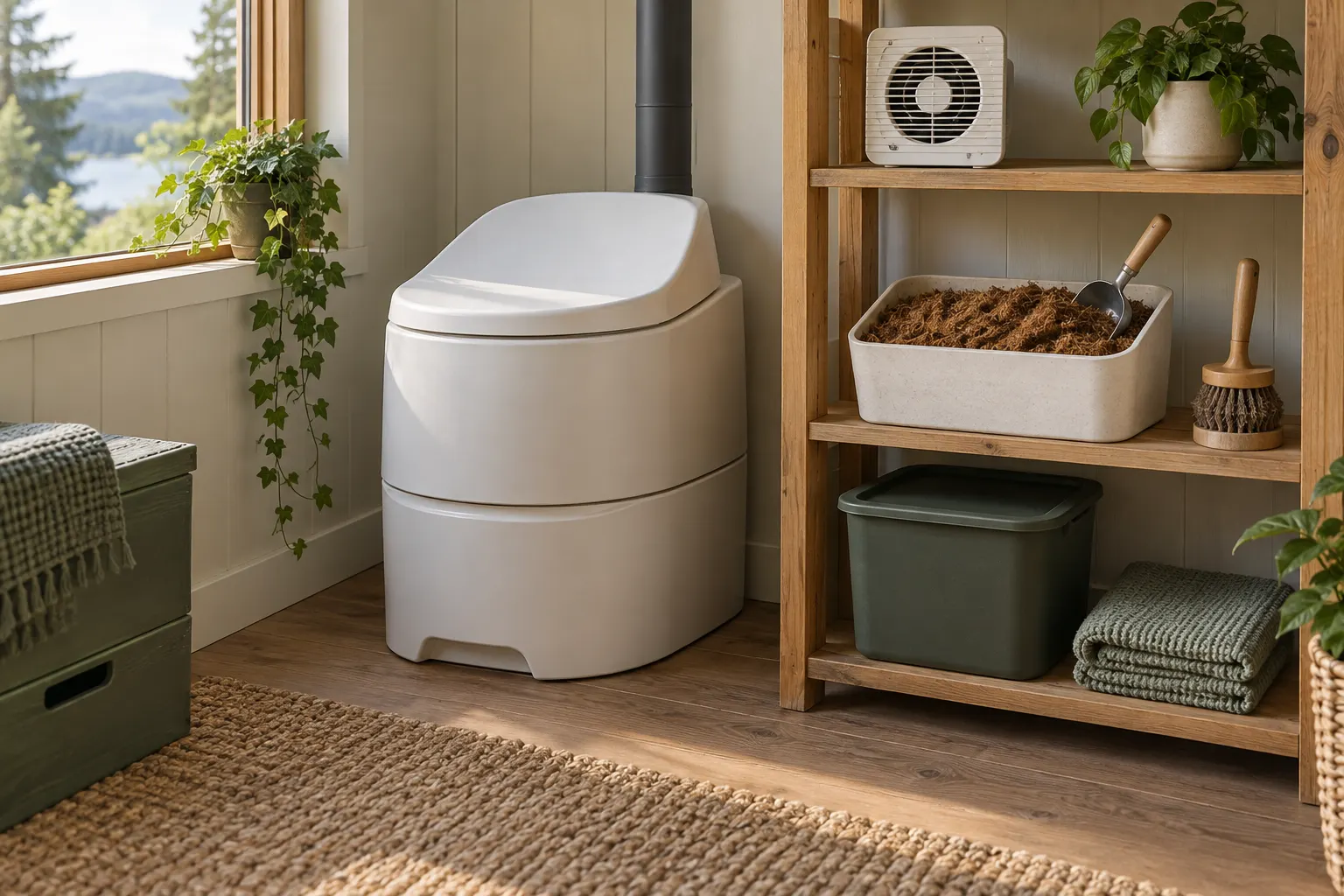
Compare toilet ownership costs by asking which uncertain assumption could change your choice. Start with two suitable options, calculate both over the same period, then vary usage and recurring costs. If a small change reverses the result, gather better evidence before choosing on cost.
Our complete ownership-budget guide helps identify the expense categories. This article takes the next step: deciding whether the comparison is stable enough to act on. The worked figures below are invented dimensionless cost units, with no connection to a product, currency or market price.
Compare options that meet the same need
First define the service you need: the users, location, expected periods of use and servicing access. Exclude an option that does not meet those requirements before comparing totals. Our use-case guide can help frame that first decision.
Give both remaining options the same ownership period and usage assumptions. Keep a written list of included items. A lower initial total is difficult to interpret if one column includes the necessary accessories and the other does not.
For a concrete example of why scope matters, Nature’s Head lists its fan, power cable, mounting hardware, vent hose and hose ends among the supplied components, while describing the exterior vent and household AC adapter separately. Use the exact package and model documentation when building your own list. Nature’s Head manuals and installation guidance
That source describes a manufacturer’s package, rather than every UK or EU seller’s offer. Confirm the contents of the particular supply arrangement you are considering. Leave an unresolved accessory as an unknown input until you have evidence for it.
Give each recurring input the right driver
Do not make every cost rise with the number of nights away. Create separate rows for purchase and preparation, annual commitments, use-dependent consumables and replacements. Add a note explaining what makes each row increase.
For example, Trelino describes a solids container lined with a bag and used with litter material. Its FAQ also says the bag does not need changing after every use. Those instructions support separate bag and litter assumptions rather than an automatic one-bag-per-visit calculation. Trelino operating FAQ
Power needs its own schedule too. Nature’s Head describes its fan as designed for continuous operation and provides further guidance about extended periods without use. Build the operating schedule from the instructions for your exact model, rather than assuming that fan hours equal occupied hours. Nature’s Head fan guidance
These examples identify inputs to investigate. They do not establish comparative costs between those manufacturers. Use your own documented quantities and consistently obtained cost inputs in the ownership-cost comparison tool, retaining a copy of the assumptions alongside the result.
A hypothetical threshold calculation
Imagine two unnamed options that already meet the same practical requirements. Assume a three-year ownership period, no resale credit and no replacement event. Every figure here is an invented dimensionless cost unit.
Option A has an initial cost of 300 units and a variable cost of 2 units per occupied day. Option B has an initial cost of 540 units and a variable cost of 1 unit per occupied day. For this deliberately simplified exercise, all other costs are assumed equal and omitted from both columns.
At 40 occupied days each year, there are 120 occupied days over three years. A totals 300 + 2 × 120 = 540 units. B totals 540 + 1 × 120 = 660 units.
At 100 occupied days each year, there are 300 occupied days over three years. A totals 900 units and B totals 840 units. The ordering changes because the invented usage assumption changes.
The initial difference is 240 units, and the variable-rate difference is 1 unit per occupied day. Equality therefore occurs at 240 occupied days over the period, or 80 per year when spread evenly across three years. This is a mathematical threshold within the example, not a forecast for any toilet.
Challenge the input that creates the threshold
Now keep the initial figures but question the variable rates. If A’s rate were 1.5 units per day instead of 2, the rate difference would become 0.5 units. Equality would move to 480 occupied days over three years, or 160 per year.
That change tells the hypothetical buyer what to investigate next: the evidence behind variable consumption. Rechecking an unrelated small accessory would not resolve the central uncertainty in this example.
For your own comparison, change one uncertain input at a time. Record whether the preferred option changes and the value at which that happens. Then build a combined cautious scenario using assumptions you can explain. Avoid presenting a narrow numerical result when its inputs remain broad guesses.
Keep uncertain replacements visible
Add a separate scenario for a replacement event if you want to understand its effect. Label the event as hypothetical unless supported by evidence. Including a replacement does not establish that a component will fail within your chosen period.
Apply the same discipline to resale. A zero resale credit is a transparent modelling choice; an invented future resale amount adds uncertainty. If you explore one, show the result both with and without it.
Keep servicing time in a separate record unless you deliberately assign it a value. State whose time is counted and use the same method for both options. An apparently precise total becomes difficult to assess when one column quietly includes labour and the other leaves it out.
Finish with an evidence decision
Write a short conclusion naming the preferred option under your assumptions, the input most capable of reversing that preference and the evidence still missing. If your plausible scenarios all point the same way, the cost comparison is more stable within those boundaries. If they disagree, the next useful action is to resolve the influential uncertainty.
Keep practical suitability alongside the arithmetic throughout. A cost model helps you understand a choice; its useful output is a decision with visible assumptions and limits.
Continue planning
Related guides

Portable toilet comparison
Best portable composting toilet for a campervan: keep the trip simple

Capacity planning
Waterless toilet capacity: estimate a realistic emptying interval
Campervan toilet service access